
OBORDA / AVIATION INFRASTRUCTURE
A breakdown in air traffic communications can move the funding debate overnight. It does not move every contractor’s revenue overnight. As a personal investment blogger, I want to know who already has a seat at the table, what must happen before new money reaches them, and whether the stock price leaves room for the risks.
That is where OODA helps: Observe → Orient → Decide → Act. Observe the request, orient around existing contracts, decide what the business is worth, and act only when evidence and price align. A good company is not automatically a good buy.
What is the FAA asking for?
On November 13, the administration increased its aviation funding request to $50 billion following the nationwide ground stop. An earlier $30.1 billion proposal included $18 billion for airport projects and $2 billion for air traffic control towers. The detailed allocation of the enlarged request was not established in the sources reviewed.
Sources: Reuters: November 13 funding requestThis distinction matters. Airport grants, towers, network services, radar and software can involve different buyers and procurement routes. We cannot distribute the headline amount among radar suppliers or treat the earlier proposal’s categories as a final breakdown of the $50 billion.
Congress had already provided $12.5 billion for modernization in 2025. The new request is a separate policy development; it is not a confirmed $50 billion award pool. Roll Call’s November 16 account describes a possible lame-duck legislative path and political resistance. I have not treated enactment, the amount or contractor allocations as settled.
Sources: FAA: Peraton prime integrator selection · Roll Call: November 16 legislative debateWhat the outage tells me—and what it does not
DOT’s preliminary account linked the disruption to router-related network flooding during legacy maintenance involving L3Harris. L3Harris says it is assisting the investigation. That creates an execution-risk question alongside the spending opportunity. It does not establish final fault or a financial penalty.
Sources: DOT: November 14 preliminary outage account · L3Harris: November 14 responseFor investors, a modernization program has to work through a live safety-critical system. Testing, isolation, rollback and operational acceptance are part of delivery. Rushing equipment into service is not the same as creating profitable, dependable infrastructure.
Who already has a position?
| Company / linked OODA page | Evidence-backed exposure | My action at the dated reference price |
|---|---|---|
| RTX (RTX) | Radar equipment and installation; existing FAA award. | Watch at $198.58. My starter ceiling is $193.70. Wait for an acceptable entry or stronger normalized earnings; an existing award is not a reason to chase. |
| L3Harris Technologies (LHX) | Surveillance upgrades and legacy network operations; incident exposure. | Wait at $272.35. Even if the stock enters a modeled buy band, require clearer incident findings and preserved contract economics before adding. |
| Leidos (LDOS) | ERAM and tower automation products; no assumed future platform win. | Conditional starter candidate at $130.53, about 10.36 times my EPS anchor. Use a small initial allocation only if the broader business thesis is intact; retain cash for lower bands and verify the executable quote. |
| Science Applications International (SAIC) | Disclosed FAA systems-engineering/software task orders. | Watch at $150.24. My starter band ends at $128.40. Require either a lower price or verified higher sustainable earnings before increasing the valuation allowance. |
| AT&T (T) | $74.3 million funded FENS startup planning order. | Conditional small starter at $22.18 on the broader AT&T cash-flow thesis. The FAA opportunity alone is insufficient reason to buy. |
| AECOM (ACM) | FAA architecture/engineering vehicle; new task orders must be won. | Wait for the scheduled earnings release. At $70.50 the stock is above my $64.80 starter ceiling using the conservative EPS anchor. Refresh the whole assessment after results. |
| Indra (Madrid: IDR) | $342 million existing radar award; Kansas-area production. | Watch; complete per-share valuation before setting numerical buy zones. |
Peraton also matters. The FAA selected it as prime integrator in December 2025. It is privately held, so there is no direct Peraton common-stock ticker to buy. Its coordinating role does not mean it keeps the value of every subcontract. I would not substitute an unrelated public stock as a supposed direct proxy.
Sources: FAA: Peraton prime integrator selection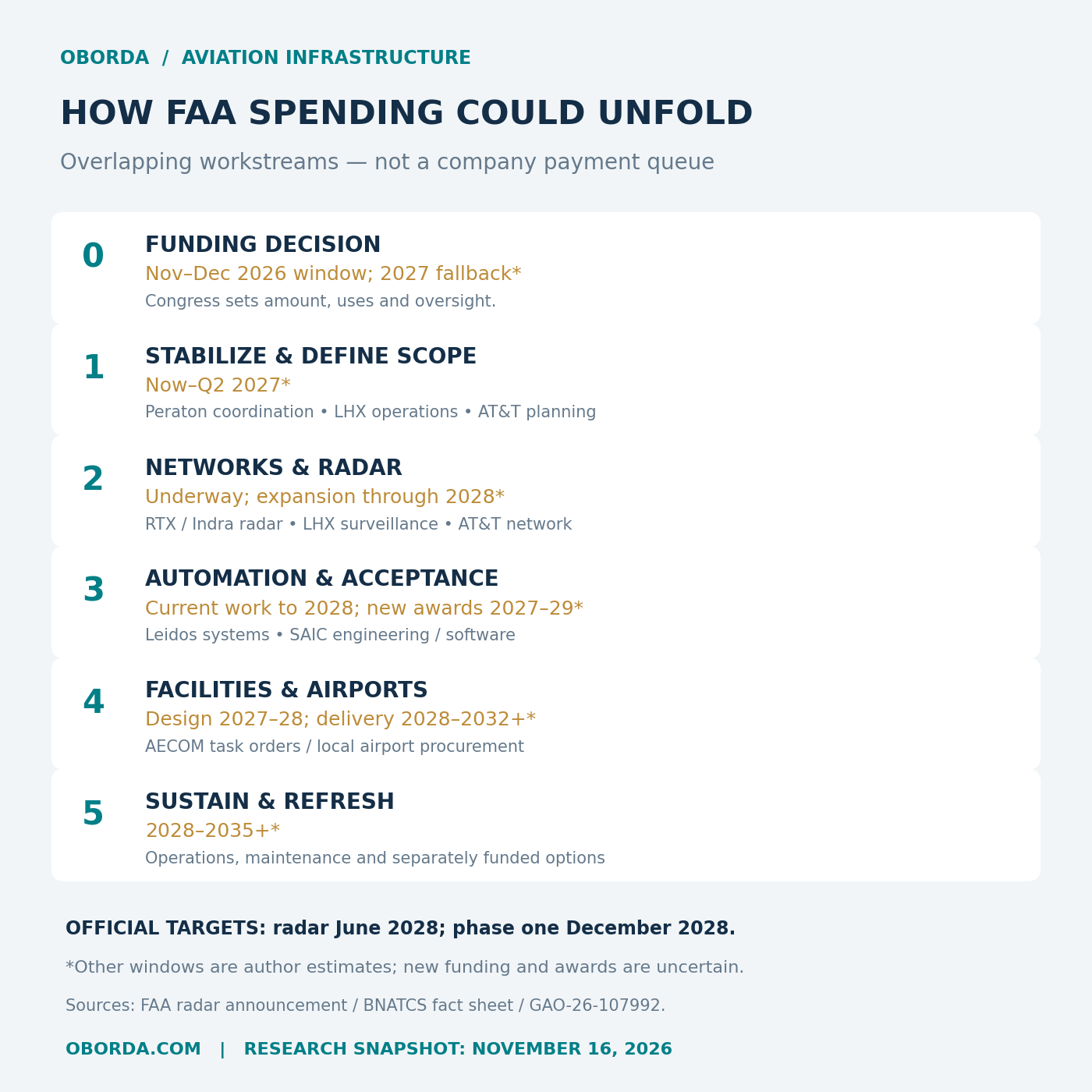
Who gets paid first? My staged roadmap
There is no verified company-by-company queue. RTX does not have to wait for this request to begin benefiting: its radar award already exists. Nor must network work finish nationwide before software or design work starts. The following stages describe likely work and cash-flow dependencies. They are my investment roadmap, not the FAA’s official numbered phases or promised award dates.
| Stage | Timeframe | What happens | Relevant companies | Confidence / gate |
|---|---|---|---|---|
| 0 · Funding decision | Nov–Dec 2026 political window; Q1–Q2 2027 fallback estimate | Congress decides amount, permitted uses, oversight and availability. A signed appropriation is the funding gate. | No company is entitled to new money merely because it is on this list. Existing work continues under existing funding. | Low on enactment timing; high that enactment matters. |
| 1 · Stabilize and define scope | Now–Q2 2027 estimate; partly underway | Investigate outage, validate architecture, specify resilience, testing, network scope and procurement packages. | Peraton coordination; LHX existing operations; AT&T funded startup planning; engineering support as tasked. | Medium on work sequence; low on new allocations. |
| 2 · Communications and surveillance deployment | Already underway in 2026; 2027–2028 expansion window | Place funded orders, manufacture equipment, install, test and cut over sites. Telecommunications is a priority. | RTX and Indra radar; LHX surveillance; AT&T network work if additional scope is awarded. | High on existing roles. Radar target: June 2028; achievement remains uncertain. |
| 3 · Automation, integration and operational acceptance | Existing deployments now–2028; new-platform procurements 2027–2029 estimate | Deploy tower tools, integrate data and safety controls, conduct acceptance. Future common automation requires further decisions. | LDOS established automation; SAIC engineering/software support. Future platform winners remain unconfirmed. | Medium on current products; low on new-platform awards and dates. |
| 4 · Facilities and airport delivery | Planning/design 2027–2028; larger delivery 2028–2032+ estimate | Design and permit towers/terminal work, award local or federal contracts, build and commission. Design can overlap earlier stages. | AECOM through FAA task orders or airport owners; other designers and builders compete. | Medium on capability; low on company-specific incremental share. |
| 5 · Sustain and refresh | 2028–2035+ estimate; some existing terms extend further | Operate, maintain, patch, train and refresh equipment. Services may overlap installation and require separate awards. | Winning suppliers and service contractors, subject to funded options and recompetes. LHX surveillance award runs through 2045. | Medium on continuing need; low on future margins and vendor shares. |
The FAA’s official modernization structure is different: GAO describes a first phase of existing system investments targeted for December 2028, and a second phase involving new automation. GAO reported that officials had no estimate for phase two’s start or completion. My 2027–2029 procurement and 2030s deployment windows are therefore analytical scenarios, not government commitments.
Sources: GAO: modernization cost and schedule review, September 2026Why a contract announcement is not immediate cash
The practical chain is appropriation, allocation, funded contract action, delivery, revenue recognition and collection. Existing contract modifications can move faster than a new competition. A contract ceiling sets potential capacity; an obligation commits funding; revenue depends on performance and accounting; cash arrives according to billing terms. Advances and progress payments can alter the order. Company reports must establish the actual economics.
Facilities are especially easy to misread. If Congress funds airport grants, local airport authorities may hire designers and builders. The beneficiary may receive an airport contract rather than an FAA check. AECOM’s design work could start early, while a terminal’s main construction spending takes years.
My OODA investment ranking
Clearest established radar exposure: RTX and Indra. Both have awards. That supports the business connection but does not prove that either stock is cheap.
Most interesting conditional valuation candidate among the reviewed U.S. names: Leidos. Its existing FAA automation role and approximately 10.4× adjusted EPS reference multiple merit further attention. Future common-platform selection remains competitive and uncertain.
Communications candidate with diluted FAA materiality: AT&T. The recorded startup order is real; the parent investment still depends mainly on telecom cash flow and capital allocation.
Higher evidence hurdle: L3Harris. An established FAA role comes with incident risk. I would wait for greater clarity on the investigation and economics.
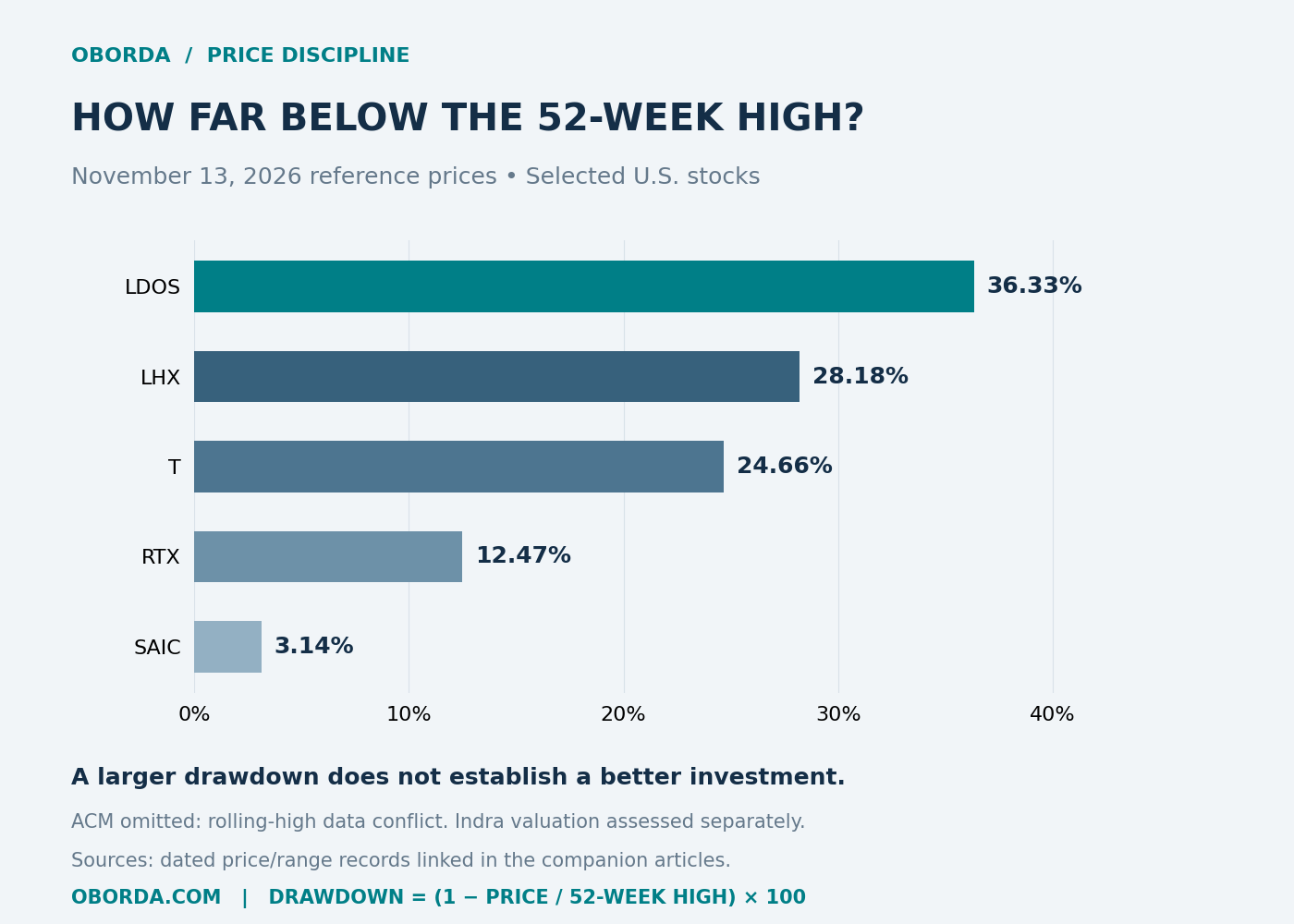
Price and results discipline: SAIC and AECOM. SAIC is close to its 52-week high; AECOM has an imminent earnings reset and recent project losses. I do not need to chase either to participate in this theme.
The price discipline behind the stock pages
The six U.S. stock pages include transparent earnings-based valuation bands and bear/base/bull sensitivities. These are provisional author models; they are not six verified chart support levels. I have not added speculative FAA revenue to earnings. Indra’s numerical grid is withheld because the per-share valuation inputs were not fully reconciled.
For each stock I ask: What is the existing business worth without the new request? How much of a funded award can become profit? What happens if the appropriation is smaller, later or redirected? If the investment only works when the full headline becomes immediate earnings, the assumptions are too aggressive.
What I will watch next
| Evidence | What it changes |
|---|---|
| Itemized request and enacted legislation | Defines eligible spending, amount, deadlines and oversight. |
| Funded task orders and modifications | Identifies actual vendor exposure; prevents counting ceilings as sales. |
| Outage findings and corrective actions | Changes LHX risk and the required resilience/testing scope. |
| Company backlog, margins and cash conversion | Shows whether public spending improves shareholder economics. |
| FAA/GAO schedule updates | Tests the 2028 target and the assumptions behind later automation. |
| AECOM November 16 results / November 17 call | Could supersede the earnings anchor and every ACM price band. |
Observe → Orient → Decide → Act
Observe: a larger funding request, existing awards and unresolved delivery risk. Orient: networks, radar, automation and facilities move on overlapping timelines. Decide: judge each stock by earnings, valuation and contract economics. Act: build the watchlist, use conditional staged entries where price qualifies, and update the thesis when funded scope changes.
My approach: buy the discount, not just the headline. Staggered purchases. No all-ins.