

OBORDA / AVIATION INFRASTRUCTURE
RTX owns Raytheon, Collins Aerospace and Pratt & Whitney. Its aviation and defense businesses give it a broad earnings base; FAA radar is one contributor rather than the whole investment case.
Observe: what is confirmed?
The FAA named RTX and Indra as radar suppliers in January 2026. Replacement work was scheduled to start that quarter, with a June 2028 target. RTX already has an award; a new appropriation is not the starting gun for all of its FAA work.
Sources: FAA: RTX and Indra radar awards, January 5, 2026Earnings and valuation
Q3 sales were approximately $25 billion. Full-year adjusted EPS guidance is $7.65–$7.75. My valuation anchor is $7.45: the $7.70 midpoint less the $0.25 Q3 IEEPA recovery, a deliberately simplified normalization rather than company guidance.
Sources: RTX: Q3 2026 resultsPrice structure
The November 13 reference price is 12.47% below the $226.88 52-week high. This is a meaningful correction, but it does not by itself establish cheapness or a durable bottom.
Sources: RTX price and 52-week rangeOrient: how the FAA story fits
This is a relatively well-supported contract thesis, but the stock needs to be justified by aerospace and defense earnings. I would not pay a separate speculative FAA premium on top of a full valuation.
Timing: Existing radar production and installation: 2026–June 2028 official target. Incremental orders from a new package: analytically 2027–2029 if funded and awarded.
Business-to-stock bridge: Funding must become an obligation, an awarded scope of work, profitable delivery and ultimately cash flow. I have not assigned this company an invented share of the proposed $50 billion.
Decide: six valuation zones
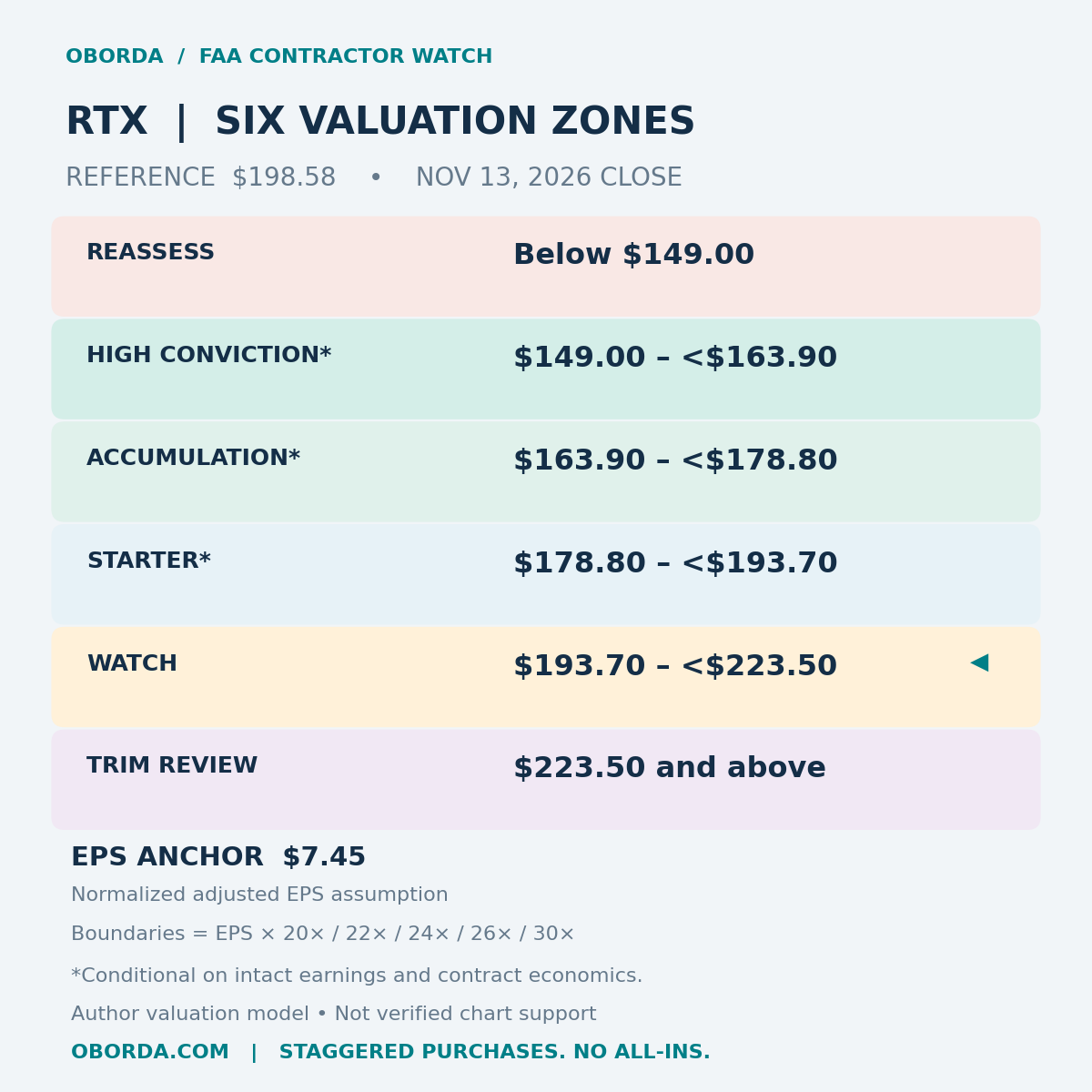
Anchor: $7.45 annual EPS; snapshot multiple: 26.66×. Boundaries equal EPS × the stated multiple. These are provisional valuation bands, not verified chart support. Multiples are my risk allowances, not peer-consensus targets. They deliberately exclude an assumed incremental FAA earnings contribution.
| Zone | Price | Boundary rationale |
|---|---|---|
| Reassess | Below $149.00 | Below 20× EPS: the price may signal a broken assumption; stop and re-underwrite. |
| High conviction — conditional | $149.00 to below $163.90 | 20–22×: deepest valuation allowance, conditional on intact earnings and contracts. |
| Accumulation — conditional | $163.90 to below $178.80 | 22–24×: larger margin of safety; stagger entries. |
| Starter — conditional | $178.80 to below $193.70 | 24–26×: smaller initial position; no presumed FAA windfall. |
| Watch / no new money | $193.70 to below $223.50 | 26–30×: insufficient discount under this model. |
| Trim review | $223.50 and above | At least 30×: review concentration and valuation; no automatic sale. |
The lowest bands permit more valuation risk only while business quality remains intact. A falling price after adverse contract news is a reason to reassess, even inside a buy band. These stocks share federal-spending exposure, so buying several is not full diversification.
12–24 month valuation scenarios
Bear: EPS falls 15% and valuation contracts to the lowest modeled multiple. Base: EPS holds and trades at the midpoint of the starter multiples. Bull: EPS grows 10% and trades at the trim-review multiple. These are conditional sensitivities, not probability-weighted expected returns. Price returns exclude dividends, taxes and fees.
| Case | EPS assumption | P/E | Implied price | Return vs reference |
|---|---|---|---|---|
| Bear | $6.33 | 20× | $126.65 | -36.2% |
| Base | $7.45 | 25× | $186.25 | -6.2% |
| Bull | $8.20 | 30× | $245.85 | +23.8% |
Risks and invalidation
Radar delivery costs, acceptance delays, aerospace execution and engine-related liabilities can overwhelm the FAA contribution.
Thesis breaks if: Material radar cancellations or repeated acceptance failures would weaken the FAA thesis. Broad earnings or cash-flow deterioration would require rebuilding the valuation.
Confidence: High on existing FAA role; medium on valuation; low on incremental share of the proposed package.
Act: my next move
Watch at $198.58. My starter ceiling is $193.70. Wait for an acceptable entry or stronger normalized earnings; an existing award is not a reason to chase.
Next evidence to check: funded task orders, award modifications, company backlog commentary, margins and cash collections. Price bands are review points, not standing orders. Staggered purchases. No all-ins.
Market context and limits
Federal procurement can proceed while the wider market falls. Higher discount rates would reduce the multiples I am willing to pay. I assign no seasonal November/December return advantage: the catalysts here are appropriations, awards and results. Current options positioning, institutional flows and a fully reconciled adjusted OHLC history were not verified; no flow claim or automated technical signal is used. The missing data limits confidence in entry timing. Refresh prices, corporate actions and earnings guidance before acting.
OODA: Observe the funded scope → Orient it against the whole company → Decide whether valuation compensates for risk → Act only when both evidence and price qualify.