

November 5, 2026 · OODA Reassessment
NVDA stock has my attention again.
Using a reference price of $181.60, NVIDIA is approximately 25.4% below its $243.37 high. That is a meaningful correction for a company still reporting exceptional growth. Market-data feeds differ slightly; this article uses one consistent price reference.
But my framework does not say a stock becomes a buy simply because it falls 25%.
A correction gets my attention. A discount has to earn my money.
The question is whether NVIDIA’s lower price offers enough compensation for the risks that helped push it there.
1. NVDA Stock Is Falling Inside a Broader AI Selloff
The selling extends beyond NVIDIA. On November 5, the S&P 500 fell approximately 4.4%, while the Nasdaq dropped 5.5%. Investors are reassessing the AI infrastructure buildout following election results and concerns about potential restrictions on data-center development. Read the market recap.
A broad selloff can pull a strong business below a reasonable valuation. It can also signal risks that optimistic forecasts overlooked. Potential restrictions deserve attention, but proposed policies do not automatically become enacted limits.
NVIDIA also faces company-specific uncertainty. Reuters reported H200 chips awaiting Chinese import approval in Hong Kong. That adds another complication to a difficult market.
My market classification: risk-off/stressed. The decline combines broad AI repricing with NVIDIA-specific risks. I am not assigning a precise percentage of the fall to either.
The Federal Reserve held its policy rate at 3.75%–4%, citing elevated inflation. Falling Treasury yields have not prevented the equity selloff. Seasonality receives little weight against these developments and approaching earnings. Read the Fed statement.
2. Reported Growth Still Supports the Business Thesis
| Q2 fiscal 2027 | Result |
|---|---|
| Revenue | $96.2 billion; up 106% year over year |
| Data Center revenue | $89 billion; up 117% |
| Adjusted EPS | $2.22 |
| Gross margin | 75% |
| Next-quarter revenue guidance | $108 billion, plus or minus 2% |
Guidance excludes China Data Center compute revenue. My calculation of quarterly free cash flow is approximately $21.3 billion, versus $69.9 billion for the first half. Receivables and inventory absorbed substantial cash; GAAP earnings also benefited from investment gains. These details make cash conversion worth watching alongside sales. Source: NVIDIA’s quarterly results.
My business assessment: strengthening in reported operating results, with future demand and cash conversion requiring attention.
NVIDIA’s software ecosystem and integrated systems support my quality assessment. Its customers still need power, financing, and acceptable returns on expensive deployments. Growth in AI usage must eventually support the spending behind it.
The next earnings report is scheduled for November 17. I want confirmation that demand remains durable, margins hold up, and sales convert into cash. NVIDIA earnings announcement.
3. NVDA Stock Valuation Has Improved—With Conditions
A lower price improves valuation only if the earnings supporting it remain credible. For this reassessment, I use three illustrative scenarios over approximately the next 12 months.
| Scenario | Forward EPS assumption | P/E assumption | Implied value | Return from $181.60 |
|---|---|---|---|---|
| Bear | $8 | 18× | $144 | −20.7% |
| Base | $10 | 23× | $230 | +26.7% |
| Bull | $12 | 27× | $324 | +78.4% |
These are my modeling assumptions, not NVIDIA guidance, verified analyst consensus, or promised targets. The EPS range brackets the latest adjusted quarterly earnings run rate and allows for further growth. The valuation multiples allow for changing confidence in that growth.
At $181.60, the base case offers approximately 27% upside against approximately 21% modeled bear-case downside. That supports a small purchase more readily than aggressive buying.
Illustrative weights of 30% bear, 50% base, and 20% bull produce a weighted value of $223, approximately 22.8% above the reference price, excluding dividends. The probabilities are judgment calls. A severe earnings shock could produce losses beyond this bear case.
The model becomes more attractive at lower entry prices only if its earnings assumptions survive. This is the central condition behind my buy zones.
4. The Chart Still Calls for Patience
Retrieved moving-average readings put the 50-day around $221 and the 200-day around $205, both above the reference price. Heavy trading volume gives the decline additional weight. The figures come from market-data snapshots and should be refreshed before trading.
- $180–$182: the immediate area being tested; a durable floor is unconfirmed.
- Around $165: near the reported $164.27 annual low.
- $196–$200: initial overhead resistance.
- $205–$221: a broader recovery hurdle.
- Around $228: the previous breakout area.
A sharp rebound would not automatically repair the structure. I want to see whether buyers can hold a level, establish a base, and reclaim resistance. Historical trading data and technical snapshots support these references.
Heavy volume does not identify the sellers. I am not assuming shorts caused the decline. NVIDIA’s repurchase authorization offers potential demand, but it cannot guarantee a price floor.
5. My NVDA Stock Buy Zones and Buying Plan
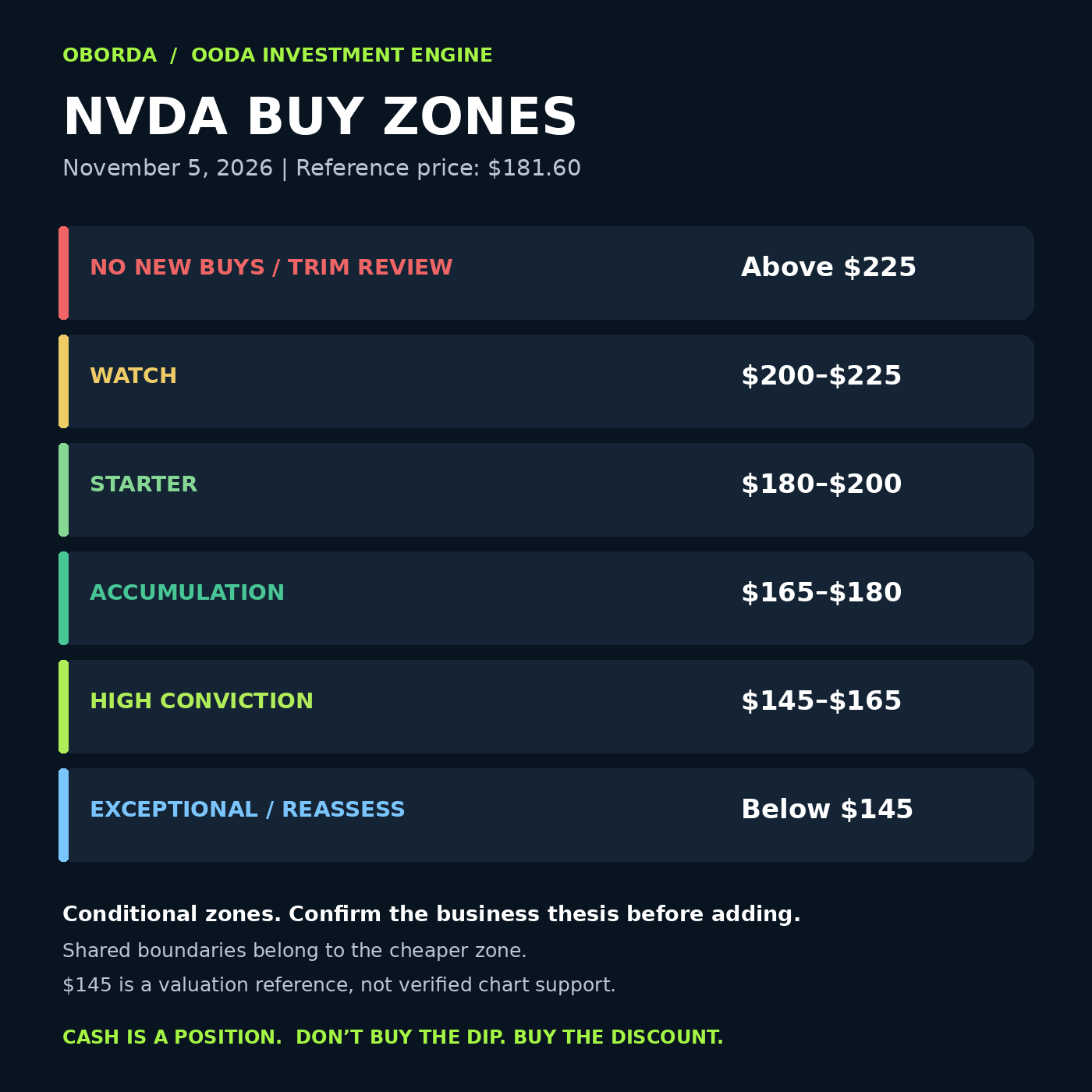
| Zone | Price | My approach |
|---|---|---|
| 🔴 No New Buys / Trim Review | Above $225 | Review valuation, resistance, and concentration. |
| 🟡 Watch | $200–$225 | Require confirmation or improved earnings expectations. |
| 🟢 Starter | $180–$200 | Consider a small initial purchase with the thesis intact. |
| 🟢🟢 Accumulation | $165–$180 | Consider staged additions after investigating further weakness. |
| 🔥 High Conviction | $145–$165 | Require renewed business confirmation. |
| ⚡ Exceptional / Reassess | Below $145 | Rebuild the valuation and investigate possible deterioration. |
Shared boundaries belong to the cheaper zone: $200 is Starter, $180 is Accumulation, $165 is High Conviction, and $145 remains High Conviction. Below $145 triggers Exceptional / Reassess.
The upper ranges reflect broken support and overhead resistance. Accumulation approaches the annual low. $145 is a valuation reference from the bear scenario, not verified chart support. At $165–$180, the price represents roughly 16.5–18 times the $10 EPS assumption; at $145–$165, roughly 14.5–16.5 times.
“High conviction” remains conditional. A falling price cannot create conviction if earnings expectations are collapsing alongside it.
My OODA Decision
Observe: NVIDIA is approximately 25% below its high amid heavy selling across AI stocks.
Orient: Reported growth supports the business thesis. Policy uncertainty, deployment constraints, and technical damage increase the risk of buying too quickly.
Decide: Around $180–$185, I see a reasonable opportunity for a small starter purchase when portfolio exposure allows.
Act: I would deploy approximately 15%–20% of the money planned for this purchase campaign, keeping the remainder available for lower prices or stronger confirmation. That percentage refers to the planned purchase, not the entire portfolio.
For an existing position, the same price does not automatically justify adding. Concentration, available cash, and opportunity cost still matter. A weak rebound into $205–$225 could justify a concentration review; it does not automatically justify selling a winner.
What would change my view? A material guidance cut, persistently weaker cash conversion, margin deterioration, or restrictions that meaningfully reduce demand would require a new valuation before adding. Strong earnings and a sustained technical recovery could justify revising the zones upward.
Confidence: Moderate. The discount is more compelling. Evidence of a durable bottom is still developing.
Cash is a position. Don’t buy the dip. Buy the discount.
Explore more analysis at OBORDA.
Disclosure: I own NVIDIA. This article reflects my personal research and decision framework for educational purposes and is not individualized investment advice. Prices, assumptions, and buying ranges can change as new information becomes available. Figures are dated November 5, 2026; refresh them before making a decision.