
OODA Market Humor | October 30, 2026
Apparently, we’re having this conversation every year now.
It’s October 2026, and Wall Street has made another shocking discovery:
Artificial intelligence costs money. A LOT of money.
Somebody alert the financial media!
For the past several years, investors have repeatedly questioned whether technology companies are spending too much on AI infrastructure and whether those investments will generate enough profit.
The conversation has become remarkably familiar:
Illustrative summary of recurring investor debates, not literal quotations or claims that each concern was unique to a given year.
At this rate, in 2027 somebody is going to discover that data centers need electricity.
Oh, wait. We already discovered that, too. 😂
Meanwhile, the Market Is Getting Defensive
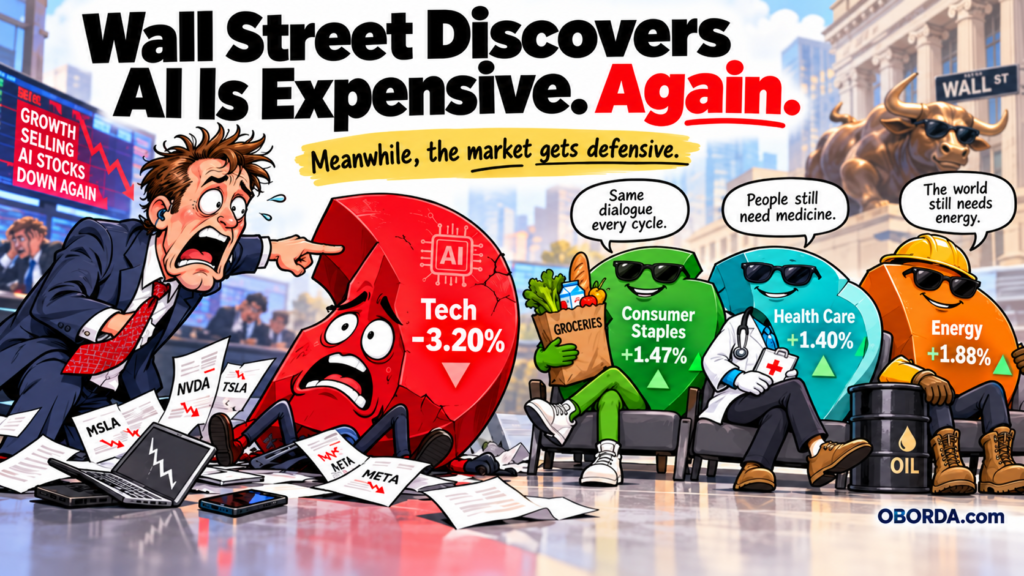
As of approximately 10:05 a.m. ET on October 30, the sector performance board was telling an interesting story:
| Sector | Intraday change |
|---|---|
| Information Technology | −3.20% |
| Consumer Discretionary | −1.18% |
| Energy | +1.88% |
| Consumer Staples | +1.47% |
| Health Care | +1.40% |
Source: sector-performance screenshot, October 30, 2026, 10:05 a.m. ET. Intraday figures—not closing returns.
Technology was getting hammered while investors were suddenly enthusiastic about groceries, medicine, and energy.
Apparently, when Wall Street gets nervous about the future, it remembers that people still need food, prescriptions, and electricity.
Welcome to defensive investing: when your portfolio starts behaving like your grandparents’ shopping list. 😂
But there’s more happening than another debate about AI spending.
Enter the Federal Reserve: The Party Guest Who Won’t Leave
On October 28, the Federal Reserve maintained its benchmark interest-rate range at 3.75%–4.00%. Inflation remained elevated, and two policymakers favored a quarter-point rate increase.
Borrowing costs influence corporate investment, consumer spending, and stock valuations. Higher rates can put particular pressure on companies whose valuations depend heavily on profits expected far into the future—even when some of their spending is funded internally.
So Wall Street wants technology companies to build the future, spend less money, generate more profits, and accomplish everything while financing is expensive.
Basically, build a spaceship. Just don’t spend too much on the spaceship.
And preferably have it generating positive cash flow before takeoff.
And Then There’s Geopolitics
Remember when investing was supposedly about earnings, revenue, and business fundamentals?
Those still matter. But investors also have to consider international conflicts, energy supply disruptions, trade policy, and political uncertainty.
On October 30, reports of a tanker attack in the Strait of Hormuz helped lift oil prices amid broader supply concerns, according to Reuters’ market coverage.
Higher oil prices can benefit energy producers while raising transportation, manufacturing, and household costs elsewhere in the economy.
So energy stocks can celebrate while other businesses receive a larger fuel bill.
The market has apparently found a way for expensive oil to be both good news and bad news.
Congratulations. Everybody wins. Except possibly the person filling up the gas tank.
Oh, and We Have an Election Coming Up
The November 3 U.S. midterm elections bring another layer of policy uncertainty. Investors may be watching what a different congressional balance could mean for taxes, regulation, trade, and federal spending.
But an approaching election doesn’t automatically mean stocks should fall. Markets respond to expectations, surprises, and actual policy developments—not simply the existence of Election Day.
Still, Wall Street now has another subject to debate between AI spending warnings.
At least we’re keeping the financial commentators employed.
Here’s What Actually Makes October Interesting
There is a legitimate difference between repeating an old warning and responding to new financial evidence.
Recent earnings revived questions about cash flow, capital spending, and profitability. Reuters reported on October 30 that Amazon’s AI-related investment spending and Intel’s cash-burn warning unsettled investors. Alphabet also faced sharp selling following concerns over its results and AI expenditures.
These aren’t imaginary concerns.
AI’s long-term potential isn’t necessarily what investors are debating. The bigger question is timing. If monetization develops more slowly than expected while capital expenditures continue rising, today’s valuations could prove difficult to justify.
That’s a legitimate risk.
At the same time, AI’s enormous long-term commercial potential remains part of the investment case.
Both statements can be true.
The bigger question isn’t whether AI infrastructure is expensive. We’ve known that for years.
It’s whether projected future earnings justify today’s valuations—and whether investors have accurately assessed the cost, scale, and timing of those earnings.
Each earnings season provides new evidence that can either strengthen or weaken the investment case.
The real challenge is distinguishing genuinely new information from recurring concerns investors already understood.
That’s a financial question, not a reason to assume every pullback signals the end of the AI story.
The OODA Perspective: Observe Before You Panic
At OBORDA, the response isn’t to declare the end of the AI boom every time technology stocks decline. It’s to examine what has actually changed.
Observe: Technology is underperforming while several defensive sectors are advancing.
Orient: Examine earnings, AI capital expenditures, free cash flow, rates, oil prices, geopolitical risks, and valuations.
Decide: Determine whether lower prices reflect weaker fundamentals, changing expectations, or potentially better investment opportunities.
Act: Follow an investment plan rather than chase headlines.
A defensive rotation deserves attention. It can reflect genuine concern about earnings, economic conditions, or valuations. But one morning’s sector performance is not a recession forecast.
Sometimes the price changes more than the business. Other times, the business outlook really has changed.
That’s why we examine the evidence instead of treating every red trading day like an economic emergency.
OODA Bottom Line: Same Conversation, New Evidence
Wall Street has been warning about AI spending for years. That doesn’t make those warnings wrong. Every earnings season provides new data that can reinforce or challenge the original thesis.
The question is whether the latest results materially change the outlook or simply remind investors of risks that were already part of the equation.
Meanwhile, the Federal Reserve is watching inflation. Investors are watching AI spending. Energy traders are watching geopolitics. Political analysts are watching the midterms.
And I’m watching Wall Street revisit a conversation we’ve been having for years.
At this point, the only thing more predictable than AI spending is Wall Street repeatedly debating how much that spending is actually worth. 😂
OBORDA.com — Observe. Orient. Decide. Act. And occasionally laugh at the market.
Sources and Reading
- Federal Reserve: October 28, 2026 FOMC statement
- Reuters: Amazon and Intel results deepen AI spending concerns (October 30)
- Reuters: October 30 global market overview and oil supply concerns
- Associated Press: Technology selling and strength elsewhere in the market
Market humor and commentary, not personalized financial advice. Sector figures reflect a specific intraday snapshot and may differ from closing prices.