
OODA Sector Reassessment · Part 1 · NFLX / SKYD / ORCL
Netflix has outlasted deep-pocketed rivals. The newly consolidated Skydance empire presents a different question: does NFLX still deserve the same valuation assumptions?
Netflix has survived competition from Disney, Amazon, Apple, Comcast, and some of the world’s wealthiest technology companies. But a new development deserves investors’ attention.
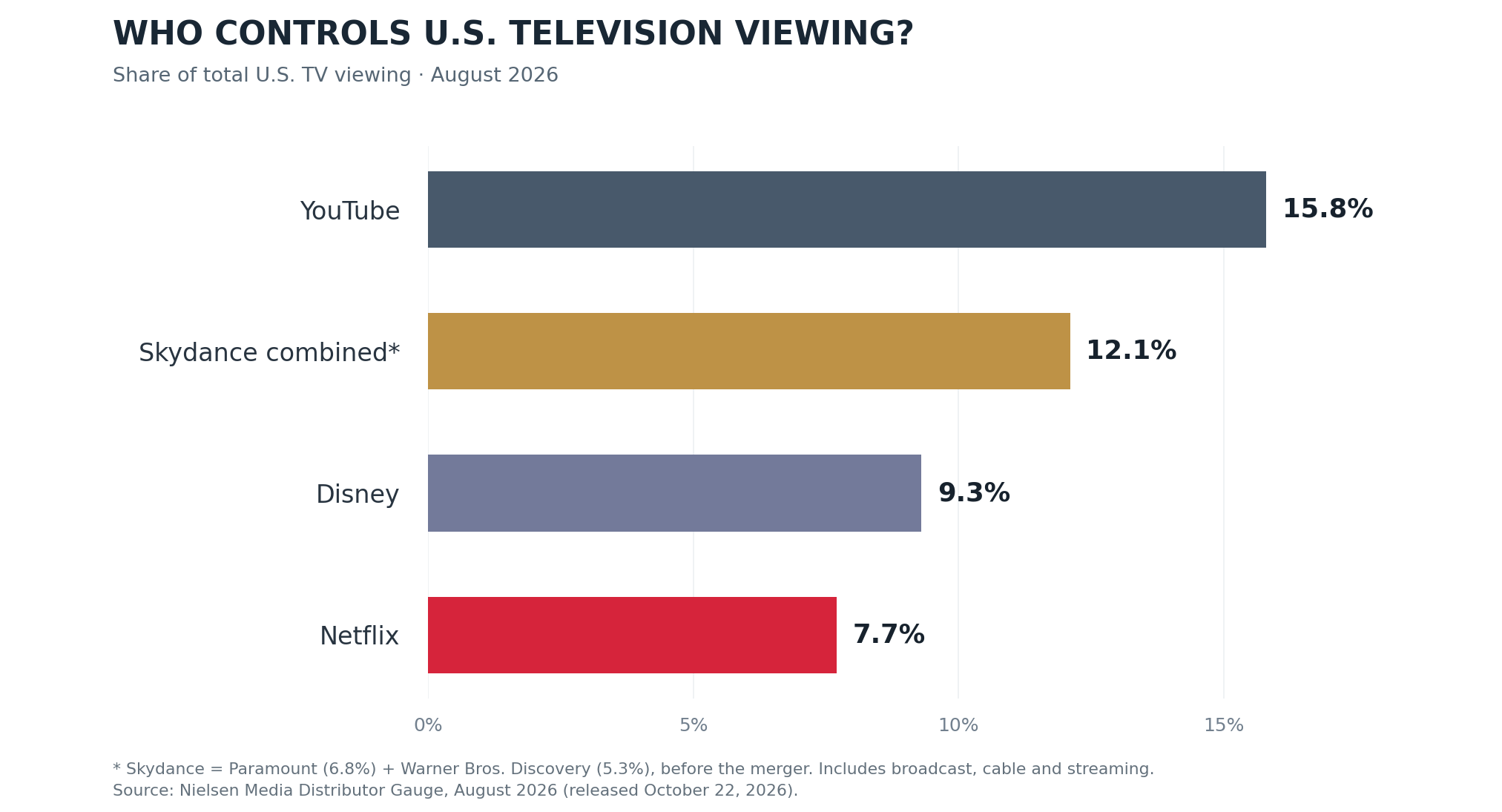
Collectively, the Paramount and Warner Bros. Discovery businesses now controlled by David Ellison accounted for approximately 12.1% of total U.S. television viewing in August 2026, compared with Netflix’s 7.7%.
That comparison includes traditional television and streaming, and the figures predate the merger. Netflix still commands considerably more streaming-only viewing. Nevertheless, the numbers illustrate the scale of the entertainment empire David Ellison has assembled with financial backing from his father, Oracle co-founder Larry Ellison.
The investment question isn’t whether the Ellisons are wealthy enough to compete. It’s whether the combination of Hollywood assets, technology relationships, and acquisition experience changes Netflix’s future growth assumptions.
The Streaming Wars Have Changed
Netflix’s competitors are no longer simply companies offering alternative streaming subscriptions.
Disney combines franchises, sports, theatrical releases, and streaming. Amazon uses Prime Video within a larger retail and technology ecosystem. Comcast controls NBCUniversal, Peacock, and major sports programming. Google’s YouTube competes for television viewing time and advertising dollars.
In Nielsen’s August 2026 report, YouTube reached 15.8% of total U.S. television viewing—more than twice Netflix’s share. Fox is also pursuing a proposed $22 billion acquisition of Roku, potentially bringing together Tubi, premium sports and news programming, a connected-TV platform, and first-party distribution data.
Competition now extends beyond subscriber counts. It is a contest over audience attention, advertising, intellectual property, and access to consumers.
Why the Ellisons May Be Different
Netflix has faced wealthy competitors before. Several already possess major entertainment libraries and sophisticated technology. What distinguishes the Ellison-led Skydance is the consolidation of two Hollywood businesses under leadership backed by Larry Ellison’s capital and acquisition record.
Following the October 6, 2026, acquisition of Warner Bros. Discovery, Skydance combines:
- Major studios: Warner Bros. and Paramount Pictures.
- Premium intellectual property: Harry Potter, DC, Game of Thrones, Top Gun, and SpongeBob SquarePants.
- Broadcast and news: CBS, CNN, and extensive cable operations.
- Sports: Programming through CBS Sports and TNT Sports.
- Streaming: HBO Max and Paramount+.
- Advertising and distribution: Established broadcast, cable, and streaming relationships.
- Technology ties: A separate commercial cloud agreement with Oracle.
Disney and Comcast already possess several comparable capabilities, while Amazon has extensive technology resources. The distinction is the recent consolidation itself, and the opportunity to coordinate assets that once competed under separate owners.
After Paramount Skydance submitted a superior offer for Warner Bros. Discovery, Netflix declined to raise its bid in February 2026. The Ellisons completed the deal in October. It demonstrated a willingness to deploy substantial capital, but not that the strategy will ultimately generate superior returns.
Netflix vs. Skydance: Comparing Competitive Scale
| Metric | Netflix (NFLX) | Skydance (SKYD) |
|---|---|---|
| Paid streaming relationships | More than 325 million paid memberships at year-end 2025 | More than 200 million subscriptions across platforms at merger closing |
| U.S. total TV viewing | 7.7% | 12.1% combined, pre-merger |
| U.S. streaming-only TV viewing | 7.7% | 3.7% combined, pre-merger |
| Major programming | Stranger Things, Wednesday, Squid Game, Bridgerton | Harry Potter, DC, Game of Thrones, Top Gun, SpongeBob |
| Advertising reach | Netflix’s global ad-supported offering and Ads Suite | CBS, CNN, cable networks, and streaming ad inventory |
| Sports programming | NFL games, WWE Raw, boxing, selected live events | CBS NFL coverage, NCAA basketball, TNT Sports and other rights |
| Film operations | Netflix original productions | Warner Bros. Pictures and Paramount Pictures |
| Technology | Streaming, recommendations, Netflix Ads Suite | Streaming operations; separate Oracle cloud agreement |
Figures use different reporting dates and should not be read as unique-customer counts. The Skydance television share is a simple sum of Paramount (6.8%) and WBD (5.3%); streaming-only combines Paramount (2.3%) and WBD (1.4%). Nielsen measured both before their merger. Advertising portfolios are qualitative comparisons, not directly comparable audience measurements.
The contrast is clear: Netflix remains the larger subscription streaming platform, while Skydance has a broader mix of U.S. broadcast, cable, studio, sports, and streaming businesses. The investment question is how much of that breadth Skydance can turn into profitable growth.
Larry Ellison’s Oracle Playbook
Larry Ellison co-founded Oracle in 1977 and spent decades building it into an enterprise technology leader through aggressive competition, product development, and acquisitions.
Oracle’s acquisitions included PeopleSoft for approximately $10.3 billion, Sun Microsystems for approximately $7.4 billion, and Cerner for approximately $28.3 billion. Those deals expanded Oracle into new software, hardware, and healthcare technology markets. The company subsequently expanded its focus to cloud services and AI infrastructure.
In fiscal 2026, Oracle generated $67.4 billion in revenue, including $34 billion from cloud services, a 39% year-over-year increase. That record shows persistence and a willingness to commit resources to long-horizon strategic changes. It does not prove the same playbook will work in Hollywood.
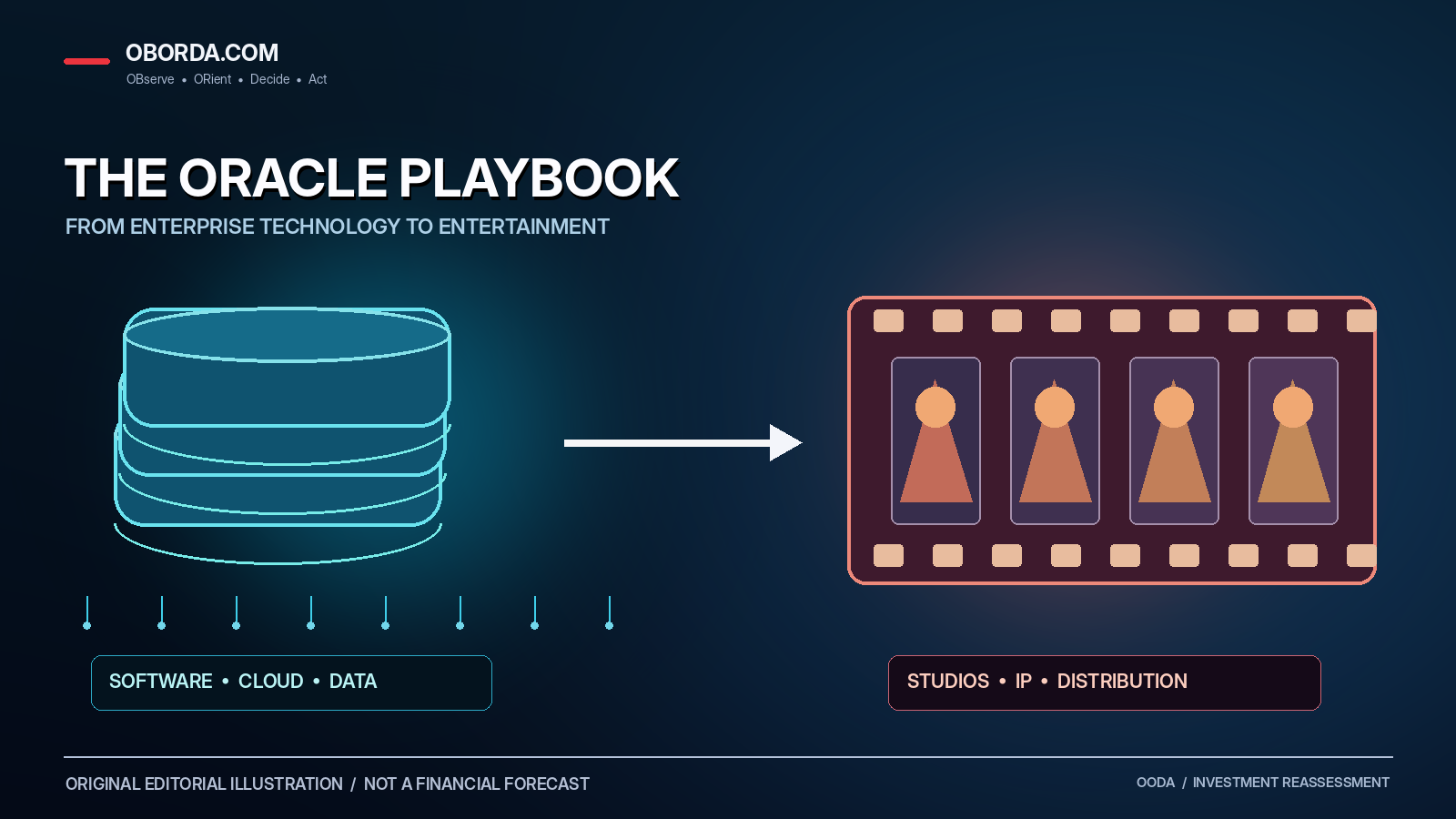
There is also a tangible business relationship. Paramount entered a six-year, $300 million cloud infrastructure agreement with Oracle for anticipated enterprise, data, and streaming workloads. Oracle is a separate publicly traded company, not a Skydance subsidiary, and the related-party arrangement warrants scrutiny.
The distinction is important: David Ellison controls the entertainment strategy; Larry Ellison contributes financial backing and acquisition experience. The combination is a potential advantage, not an automatic outcome.
The Biggest Obstacle: Debt and Execution
Skydance’s pro forma financial statements following the acquisition show approximately $82.5 billion in debt. Management is targeting at least $6 billion in annualized synergies within three years.
Integrating two large entertainment organizations while preserving their creative output is difficult. Debt servicing and cost reductions may also compete with investment in programming and technology.
Netflix faces no comparable integration challenge. Its third-quarter 2026 revenue was approximately $12.9 billion, up 12% year over year, and its operating margin reached 34.6%. Management expects approximately $12 billion of 2026 free cash flow.
That said, Netflix lowered its full-year advertising revenue forecast from approximately $3 billion to $2.7 billion, reflecting a slower-than-expected rollout of some ad products. Growth remains substantial, but the market must decide how much to pay for it.
The Case Against OODA’s Thesis
The strongest objection is straightforward: Netflix has already survived numerous well-capitalized rivals. Disney, Amazon, Apple, and Comcast all challenged its leadership, yet Netflix continued to expand internationally, improve profitability, and build its own originals and advertising operation. A new competitor does not automatically mean a diminished Netflix franchise.
Skydance’s stated scale is also not equivalent to Netflix’s. Its 200-million-plus subscriptions are spread across multiple platforms and may include customers subscribed to more than one service. Netflix’s more than 325 million paid memberships were reported within a unified platform. The distinction matters when interpreting customer reach and the economics of bundling or combining services.
Netflix’s international scale is difficult to reproduce. Netflix has spent years building recommendation systems, user experience, content discovery, worldwide distribution, and a multinational production pipeline. According to Netflix, non-English-language titles now account for more than one-third of viewing. A domestic television portfolio cannot instantly replicate that network of audiences and creators.
The merger could also reduce Skydance’s flexibility. Substantial borrowing costs, integration expenses, and pressure to realize savings may constrain future content spending. Broadcast and cable networks face structural audience declines; owning them creates cash-flow opportunities, but it also carries obligations and risks.
Finally, enterprise software and Hollywood are very different industries. Oracle’s history of successful competition demonstrates Ellison’s persistence, not his ability to forecast audience preferences, manage film franchises, or integrate creative teams.
For these reasons, investors should not assume the Ellison challenge will materially alter Netflix’s long-term economics. A credible reassessment must preserve a scenario in which Netflix’s existing advantages prevail.
OODA Reassesses NFLX Valuation
Netflix closed October 23, 2026, at $65.85, versus a 52-week high of $116.73. A lower price by itself is not a discount to fair value.
Using the company’s projected $12 billion of 2026 free cash flow and 4.106 billion shares outstanding, OODA estimates $2.92 of annual free cash flow per share. At $65.85, that implies an approximately 4.44% free cash flow yield.
To translate the competitive debate into a valuation range, OODA uses an illustrative five-year discounted cash flow sensitivity model with independently specified assumptions for growth, required return, and terminal growth.
Five-Year Cash Flow Scenarios
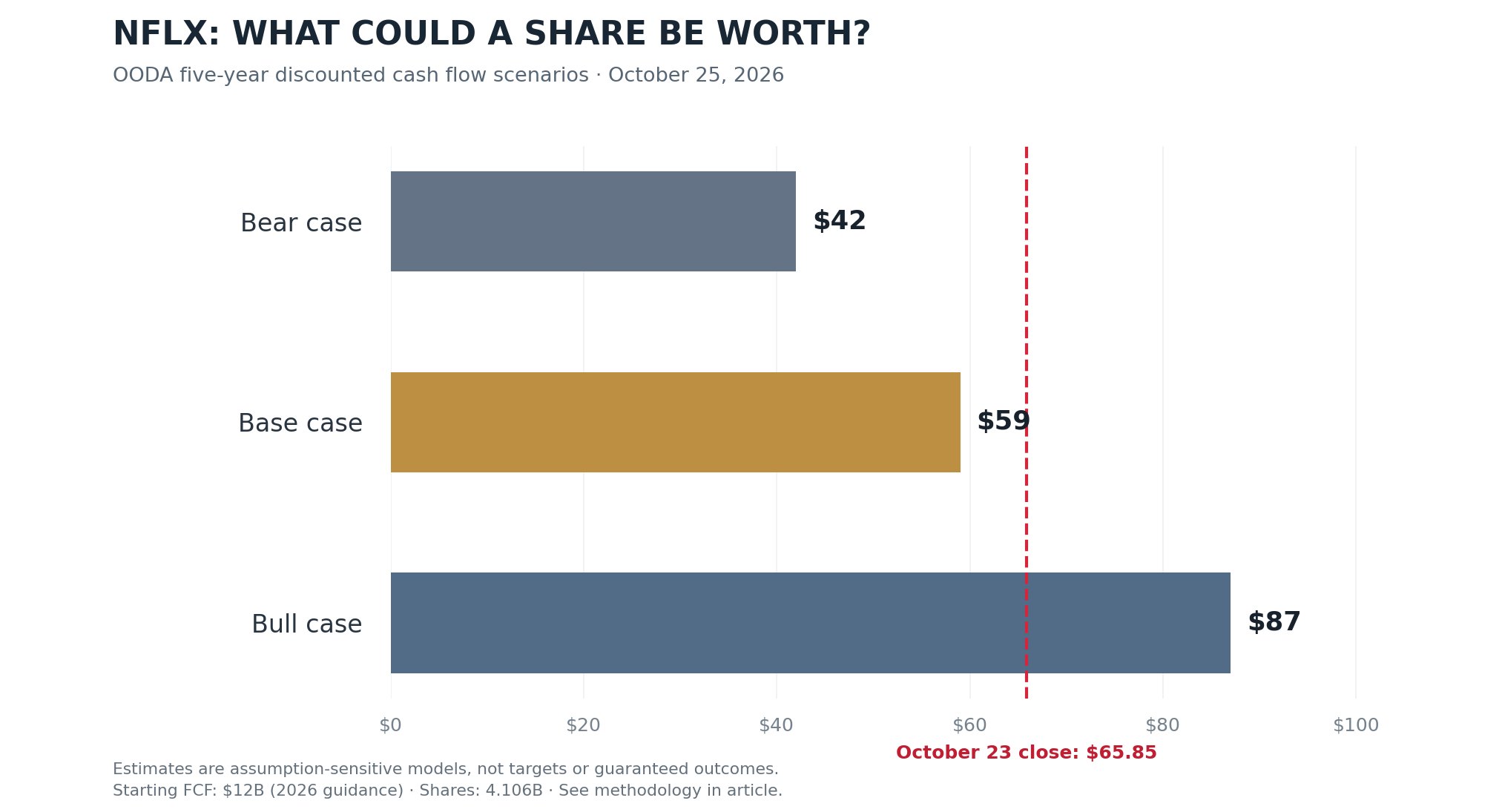
| Scenario | Estimated value | Key assumptions |
|---|---|---|
| Bear | $42 | 6% annual FCF growth, 10.8% required return, 2.5% perpetual growth |
| Base | $59 | 10%, 10%, 9%, 8%, 7% annual FCF growth, 9.5% required return, 3% perpetual growth |
| Bull | $87 | 12% annual FCF growth, 8.5% required return, 3.5% perpetual growth |
Method: discount the next five annual FCF projections and a Gordon-growth terminal value to the present, then divide by 4.106 billion shares. All scenarios start from management’s $12 billion 2026 FCF guidance and hold share count constant. This is a simplified equity FCF model; it does not explicitly forecast future balance sheet, financing, dilution, or capital-allocation changes.
The base-case estimate of approximately $59 sits below NFLX’s latest close. That does not mean the stock must fall to $59; it means OODA’s present assumptions do not support calling the current price a large margin-of-safety opportunity.
Reassessed NFLX Buy Zones — October 25, 2026
| NFLX price | OODA classification |
|---|---|
| Above $67 | No New Buys / Consider Trim |
| $59–$67 | Watch |
| $53–$59 | Starter |
| $47–$53 | Accumulation |
| $42–$47 | High Conviction — Conditional |
| Below $42 | Exceptional / Reassess |
These are valuation-derived reference ranges, not guaranteed support levels. Each lower zone demands a larger margin of safety relative to the modeled base case. The High Conviction label is conditional: if expected cash flow declines, the zones must be recalculated rather than treated as automatic buy orders.
OODA: Observe. Orient. Decide. Act.
Observe: Track Netflix’s growth, advertising rollout, operating margin, cash flow, and engagement. Monitor Skydance’s streaming integration, debt reduction, synergy realization, and content strategy.
Orient: Separate competitive headlines from measurable economic effects. Test whether Netflix’s advantages are eroding—or whether the newly combined rival is struggling to execute.
Decide: Compare NFLX’s price with its updated valuation assumptions and competing investment opportunities. Consider both business value and the timeframe of a potential position.
Act: At the October 23 closing price of $65.85, NFLX remains in the Watch zone. A more favorable entry price or stronger evidence of durable cash-flow growth would improve the case for accumulation.
The Bottom Line
Netflix remains a formidable global business. Its audience, original programming, recommendation technology, profitability, and cash generation are hard to reproduce.
But David Ellison has consolidated major Hollywood assets, while Larry Ellison brings financial backing and decades of experience using acquisitions and technological change to reshape a business.
The combination creates a competitor with meaningful positions in content, advertising, distribution, television, sports, and streaming, giving the Ellisons multiple paths to pressure Netflix’s future growth assumptions.
That does not mean those efforts will succeed. Skydance must manage debt, integrate operations, retain talent, and translate its breadth into profitability.
Investors do not need to believe the Ellisons will defeat Netflix. They only need to determine whether Netflix deserves the same valuation assumptions it enjoyed before the emergence of a newly consolidated entertainment giant.
That question may prove more important than who ultimately wins the streaming wars.
Don’t buy the dip. Buy the discount.
Cash is a position. OODA manages risk.
OBORDA.com — OBserve. ORient. Decide. Act.
Research sources
- Nielsen — August 2026 viewing report (released October 22)
- Netflix — Q3 2026 shareholder letter
- Netflix — September 2026 Form 10-Q
- Netflix — Q4 2025 shareholder letter (paid memberships)
- Skydance — October 6, 2026 merger announcement
- Skydance — Pro forma combined financial statements
- Oracle — FY2026 financial results
- Paramount — June 2026 Form 10-Q (Oracle agreement)
- Fox — Proposed Roku acquisition
- NFLX October 23, 2026 stock closing price
Investment commentary, not individualized financial advice. OODA valuation scenarios and buy zones use judgmental assumptions and must be recalculated as new information emerges.