
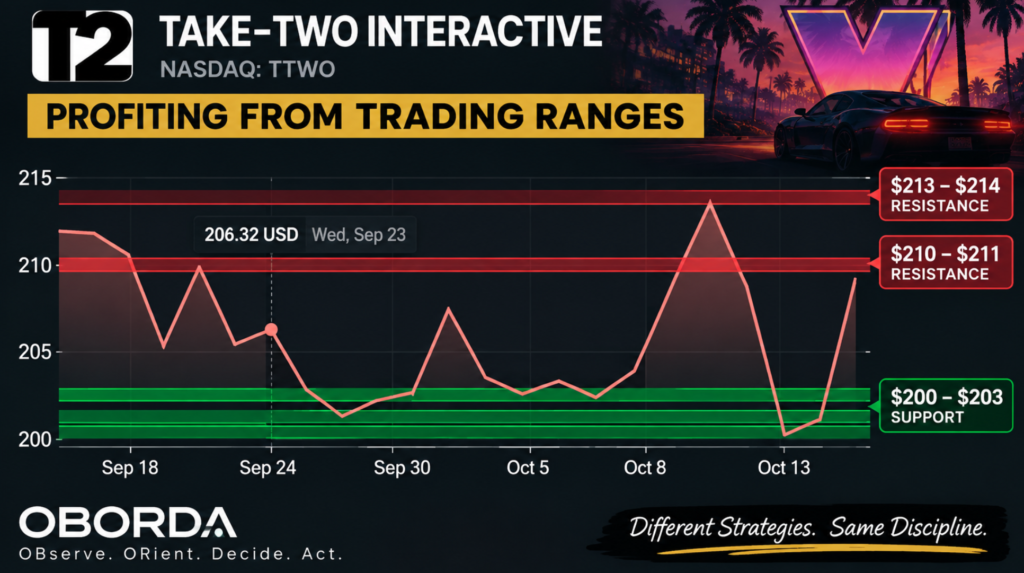

October 15, 2026 | OBORDA | NASDAQ: TTWO
Not every investment opportunity requires a stock to reach new highs. Sometimes, there’s money to be made simply playing the range.
I’ve been following Take-Two Interactive (NASDAQ: TTWO), evaluating its valuation, price movements, and the catalysts surrounding Grand Theft Auto VI. My long-term investment thesis hasn’t changed.
But TTWO has been spending a lot of time moving up, coming back down, and revisiting familiar price levels. For a stock that seems undecided about where it wants to go, it’s certainly getting around.
Those movements present another strategy worth considering: range trading.
There’s Money in the Range
TTWO has repeatedly recovered around $200–$203 while encountering resistance near $210–$214. Here’s the chart I’ve been watching. (Observe)
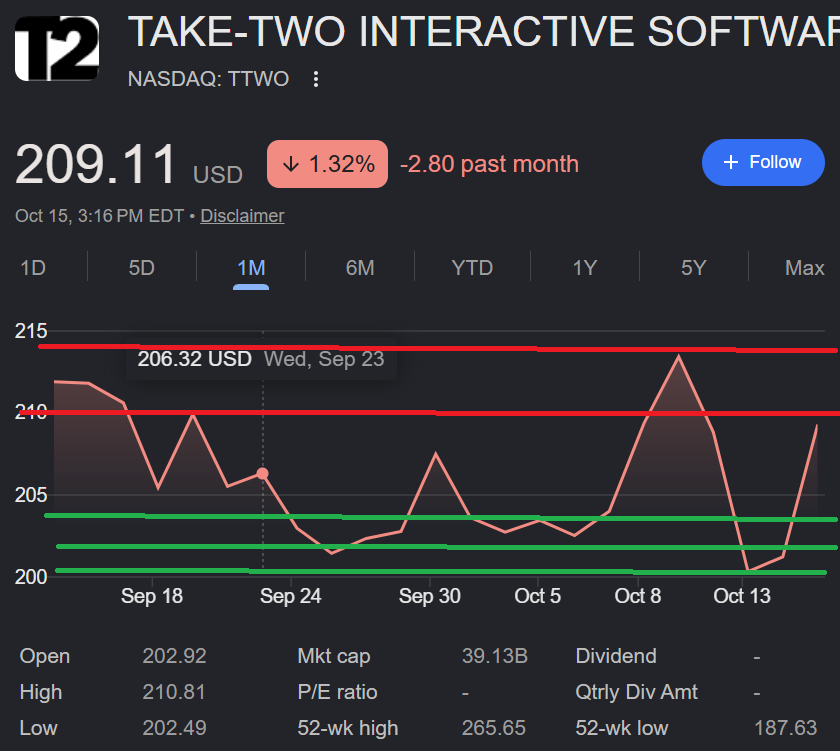
The pattern isn’t perfect—TTWO has traded outside these levels. But I’m interested in whether this range offers opportunities while I continue to follow the longer-term thesis. (Orient)
What Could a Range Trade Produce?
Suppose TTWO is purchased at $202 and sold at $212. That’s a $10 gross gain per share, or about 4.95%. You don’t need 100 shares to understand the opportunity: five shares would produce $50, and 25 shares would produce $250, before costs and taxes.
| Shares | Capital at $202 | Gross profit at $212 | Return |
|---|---|---|---|
| 1 | $202 | $10 | 4.95% |
| 5 | $1,010 | $50 | 4.95% |
| 10 | $2,020 | $100 | 4.95% |
| 25 | $5,050 | $250 | 4.95% |
| 50 | $10,100 | $500 | 4.95% |
| 100 | $20,200 | $1,000 | 4.95% |
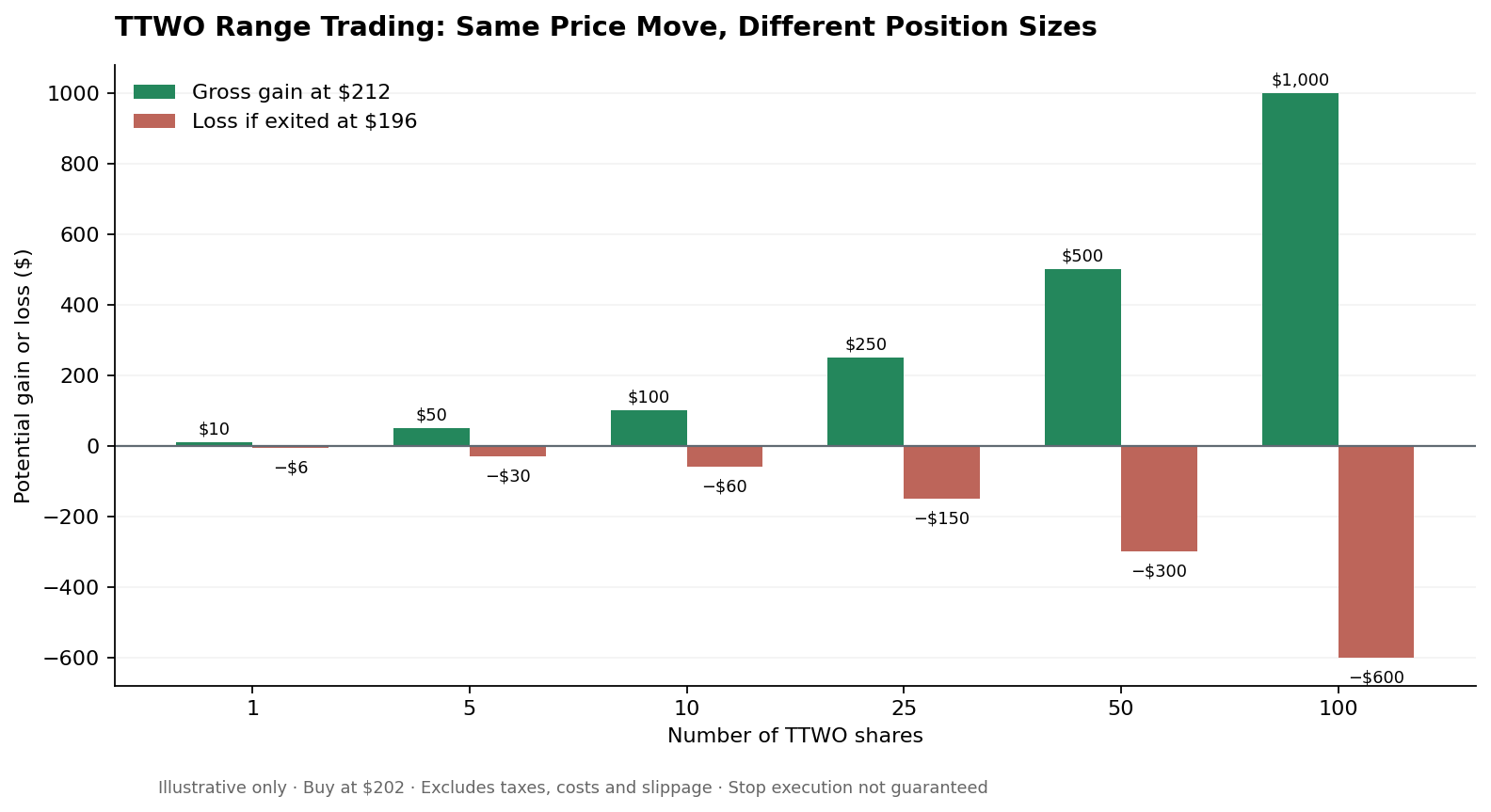
Not bad for a stock that can’t seem to make up its mind. But the reverse matters too. A decline from $202 to $196 means a $6 loss per share, assuming an exit at $196 executes. That’s a planned reward-to-risk ratio of about 1.67:1, before expenses—not automatically a good trade. The amount invested is personal; the discipline shouldn’t change. (Decide)
Trading Shares and Long-Term Holdings
My TTWO accumulation zones address longer-term ownership prices. Range trading focuses on shorter-term price behavior. An investor could maintain core shares while using a separate, appropriately sized allocation for range trades. And if the setup doesn’t make sense? Cash is a position.
What I’m Watching Next
At approximately $209.11 when I reviewed the chart on October 15, TTWO was closer to the upper part of the observed range.
- Near $200–$203: Watch whether support holds and whether the potential reward justifies the downside.
- Above $214: Reassess for a possible breakout rather than assuming resistance will hold.
- Below $200: Reevaluate the range and the risk of further downside.
If the conditions support an opportunity, I can act. If they don’t, I can wait. (Act) My September 25 update and October 13 analysis provide further context on the evolving investment thesis.
Final Thoughts
TTWO can take its time figuring out where it wants to go. In the meantime, I’ll evaluate whether there’s money to be made along the way.
OBserve. ORient. Decide. Act.
Different strategies. Same discipline.
Disclaimer: Personal market commentary, not financial advice. Range support and resistance can fail. Hypothetical outcomes exclude taxes, costs, and slippage; stop orders do not guarantee an exit price.
