
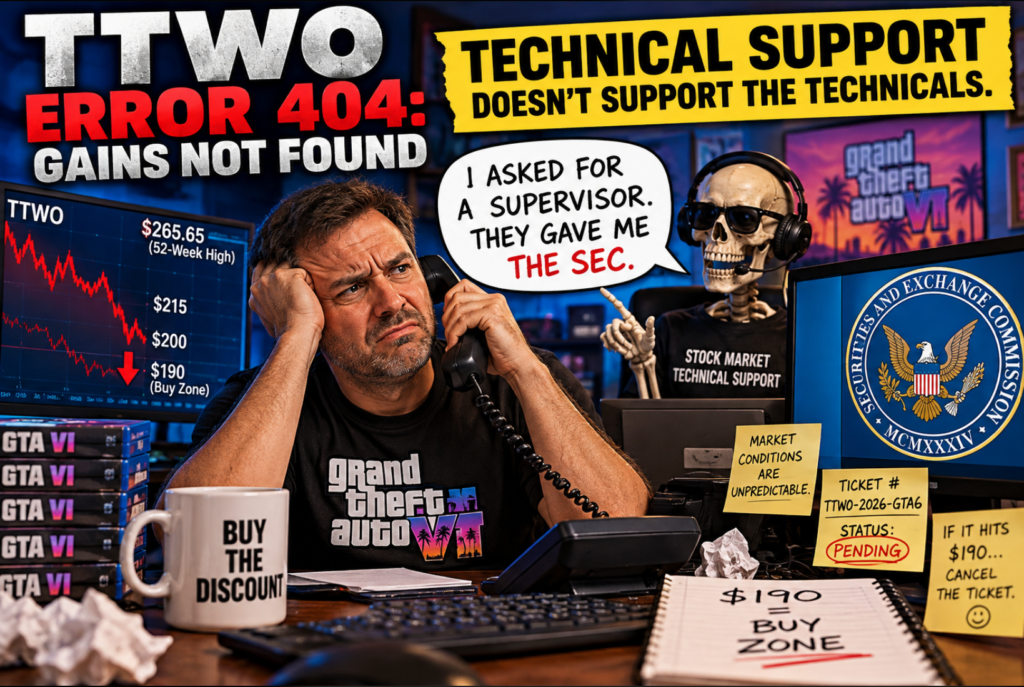

TTWO Stock Update | October 14, 2026
I’ve been watching Take-Two Interactive (NASDAQ: TTWO), and I’ve come to a very scientific conclusion:
The stock market is broken.
Something is clearly malfunctioning.
Take-Two has Grand Theft Auto VI on the horizon. One of the most anticipated video games in history. Millions of gamers are waiting to spend their money.
I’ve been following TTWO’s GTA VI developments, watching the market’s reaction, and waiting for the stock to recognize what’s coming.
And somehow, TTWO keeps finding new ways to go down.
Now, I’m an IT guy. When something isn’t working properly, I troubleshoot it.
So naturally, I called technical support.
The Call
Support: “Thank you for calling Stock Market Technical Support. How may I assist you?”
Me: “Yes, I’d like to report a malfunction. My TTWO stock keeps dropping.”
Support: “Have you tried turning the market off and back on again?”
Me: “I believe you guys do that every weekday at 4 PM. It hasn’t helped.”
Support: “Have you tried clearing your cache?”
Me: “I’ve cleared my cache, reviewed the fundamentals, checked the charts, and recalculated my buy zones. The problem persists.”
Support: “Can you describe the issue in more detail?”
Me: “Absolutely. Every now and then, the stock jumps up to around $215, so I think you’ve fixed it. Then it slowly drops right back down toward $200.”
Support: “Sir, that’s normal market volatility.”
Me: “No, that’s a malfunction. It keeps going in the wrong direction. I need it to go up to $215 and keep going, not visit $215 and come right back home.”
Support: “Have you tried adjusting your expectations?”
Me: “I’m calling to have the stock adjusted, not my expectations.”
Support: “Sir, we don’t control the direction of individual stocks.”
Me: “Then why are you called technical support?”
Support: “Because we provide technical assistance.”
Me: “Well, I’m having problems with the technicals. The stock keeps hitting resistance around $215 and falling back toward $200. I need you to fix that.”
Support: “Sir, that’s technical analysis. We don’t handle that.”
Me: “Wait a minute. You’re technical support, but you don’t support the technicals?”
Support: “That’s correct, sir.”
Me: “Then who handles the technicals?”
Support: “The market, sir.”
Me: “Well, transfer me to the market. Clearly, I called the wrong department.”
Support: “Sir, I can’t transfer you to the market.”
Me: “So you’re telling me the stock is malfunctioning, technical support doesn’t handle the technicals, and the department responsible doesn’t accept calls?”
Support: “That’s one way of looking at it.”
Me: “I’m starting to understand why this thing is broken.”
Now There’s Another Problem…
Support: “Are you receiving any error messages?”
Me: “Not exactly. But every time I open my brokerage account, it wants to send me a text message to verify it’s me.”
Support: “That’s a security feature, sir.”
Me: “But I just gave you my username and password. Who else would I be?”
Support: “The verification code confirms your identity.”
Me: “So I enter the code, and it lets me in. But then I start wondering, how does it know it’s really me?”
Support: “Because you entered the correct verification code, sir.”
Me: “But it hasn’t seen me. It hasn’t heard my voice. It hasn’t checked my fingerprints. It doesn’t even know about the birthmark on my body. How exactly has it verified that I’m me?”
Support: “Sir, the code verifies that you have access to your registered phone.”
Me: “Exactly! So you’ve verified my phone, not me.”
Support: “Sir, that’s called multi-factor authentication.”
Me: “Well, it seems like email and phone number validation to me.”
Support: “Sir, it’s an additional layer of security to protect your account.”
Me: “I understand that. But then, after I enter the code, the website asks me if I want it to remember my computer.”
Support: “Yes, sir. That’s a trusted-device feature.”
Me: “So I click yes, and now it remembers my computer?”
Support: “That’s correct, sir.”
Me: “Well, how can it remember my computer, but it can’t remember me?”
Support: “Sir, remembering your device is different from verifying your identity.”
Me: “I understand that. But you’ve verified my email, verified my phone number, and remembered my computer. At what point do you actually verify me?”
Support: “Sir, those are methods used to verify your identity.”
Me: “No, those are methods used to verify that somebody has access to my stuff. There’s a difference.”
Support: “Sir, I assure you, your account is secure.”
Me: “So let me get this straight. You recognize my computer, you trust my phone, you’ve verified my email address, but I’m the only one in this relationship who has to keep introducing himself?”
Support: “Sir, that’s how authentication works.”
Me: “I’ve worked in IT for years. I understand authentication. What I don’t understand is how my computer has established a more trusting relationship with my brokerage than I have.”
Support: “Sir, those security measures are there to protect you.”
Me: “Protect me from what? Apparently, the only thing my brokerage can’t protect me from is TTWO going back to $200.”
Support: “Sir, is there anything else I can help you with?”
Me: “Yes. Apparently everything associated with me has been authenticated except me. Meanwhile, TTWO is sitting around $200, and nobody seems concerned about verifying why it won’t stay above $215.”
Support: “Sir, are we still discussing account security?”
Me: “I don’t even know anymore. I called about a stock, and somehow we’re troubleshooting my existence.”
Support: “Sir, is there anything else I can help you with?”
Me: “Yes. Can we get back to TTWO? Because apparently my phone and computer have better credentials than this stock has technical support.”
Support: “Sir, the market appears to be functioning as designed.”
Me: “Then I’d like to speak to whoever designed it.”
I’d Like to Speak to a Supervisor
Me: “You know what? I’ve been patient, but we’re not getting anywhere. I’d like to speak to your supervisor.”
Support: “Certainly, sir. That would be the Securities and Exchange Commission.”
Me: “The SEC?”
Support: “Yes, sir.”
Me: “Wait a minute. You’re telling me I have to contact a federal regulatory agency just to get my stock to go in the right direction?”
Support: “Sir, the SEC oversees securities markets.”
Me: “Perfect. Then they should be able to oversee TTWO going back above $215.”
Support: “Sir, the SEC doesn’t control stock prices.”
Me: “So let me get this straight. Technical support doesn’t handle the technicals, the market doesn’t accept calls, and your supervisor doesn’t control anything?”
Support: “The SEC’s responsibility is investor protection and market regulation, sir.”
Me: “Well, I’m an investor, and my portfolio needs protecting. Sounds like I’m calling the right department.”
Support: “Sir, a declining stock price isn’t necessarily a regulatory violation.”
Me: “I’m not asking anybody to violate regulations. I’m asking somebody to regulate the direction this thing is going!”
Support: “Sir, that’s not how the stock market works.”
Me: “That’s what everybody keeps telling me. I’m beginning to think nobody here knows how it works.”
Support: “Would you like me to escalate this to our Market Engineering Department?”
Me: “Finally! Somebody who understands the assignment.”
Support Ticket: TTWO-2026-GTA6
Support: “Your ticket number is TTWO-2026-GTA6. Is there anything else I can assist you with?”
Me: “Yes. What’s the estimated resolution time?”
Support: “Unfortunately, sir, we cannot guarantee when the issue will be resolved.”
Me: “Can you at least tell me whether the next update will fix the problem?”
Support: “Sir, market conditions are unpredictable.”
Me: “So basically, you’ve been giving me the same runaround as the stock. A little hope, followed by absolutely no progress.”
Support: “I apologize for the inconvenience, sir.”
Me: “Don’t apologize. Just make sure the engineers understand the problem. The stock keeps going from $200 to $215 and back to $200. I need that process reversed.”
Support: “And if it drops to $190?”
Me: “Then cancel the ticket. At that point, the system might finally be working in my favor.” 😂
Meanwhile, Back in Reality…
In my October 14 intraday snapshot, TTWO was trading around $201.86, up approximately 0.77% on the day.
Yes, up.
But that doesn’t erase the larger decline from its reported 52-week high of $265.65.
Apparently, even when TTWO goes up, I still feel the need to call tech support.
Here’s what I’m observing from that snapshot:
- TTWO price: $201.86
- 52-week high: $265.65
- Decline from high: Approximately 24%
- Intraday low: $201.32
- My technical diagnosis: A serious case of GTA VI anticipation fatigue.
The frustrating part isn’t simply that TTWO has declined.
It’s the repeated recoveries that don’t seem to hold.
The stock makes a run toward $215, gets everybody’s attention, and then slowly works its way back toward $200.
In my October 13 TTWO stock update, I was already examining the recent market behavior. Today’s action keeps that conversation going.
It’s like watching a computer restart, display the Windows logo, and then crash all over again.
At some point, you stop asking whether it’s going to work and start wondering who wrote the software.
What Happens When TTWO Hits $190?
Here’s where things get interesting.
While everyone else is trying to figure out what’s wrong with TTWO, I’m watching one particular number:
$190.
That’s the lower boundary of my established accumulation zone and the beginning of my high-conviction zone.
This isn’t a number I came up with because the stock started falling.
I established my strategy in my September 24 TTWO buy-zone analysis and continued documenting my thinking in the September 25 TTWO update.
If TTWO reaches $190, I’m not calling technical support anymore.
I’m calling my broker. 😂
I’ve already established my position in TTWO. I’m not chasing the stock, and I’m not losing sleep over every red candle.
I’m waiting for the market to offer me a better deal.
At $190, I’ll be looking seriously at adding more shares, provided the fundamentals and my investment thesis remain intact.
And if it drops below $190?
Well, now we’re entering territory where my OODA framework gets particularly interesting.
My previously established high-conviction zone extends from $175 to $190.
That doesn’t mean I’ll blindly buy every decline.
It means I’ll be evaluating whether the discount has improved while the underlying business opportunity remains attractive.
A lower price alone doesn’t guarantee a bargain. But if the business outlook hasn’t materially changed, I want to understand why the market is offering an even larger discount.
That’s the difference between reacting to a falling stock and preparing for an opportunity.
I don’t buy the dip. I buy the discount.
And apparently, TTWO is considering a clearance sale.
The OBORDA Perspective
All jokes aside, price movement and business fundamentals aren’t always synchronized.
The market doesn’t care how excited I am about GTA VI. It cares about expectations, execution, future earnings, valuation, and risk.
And there’s more to Take-Two than just one game. I’ve also been following the company’s broader gaming business, including my October 8 TTWO Pokémon update.
Sometimes, however, the stock just behaves like Windows Vista.
That’s why I have an OODA framework.
Observe. Orient. Decide. Act.
Not panic. Complain. Refresh. Repeat.
Here’s how I’m approaching TTWO:
Observe: TTWO has struggled to sustain its moves toward $215. The repeated returns toward $200 have my attention.
Orient: I’m evaluating the price action against Take-Two’s fundamentals, GTA VI expectations, earnings outlook, and valuation. A declining share price doesn’t automatically mean a deteriorating business.
Decide: My established buy zones remain my reference points. I’m particularly interested in $190, where my high-conviction zone begins, but any additional purchase depends on the thesis holding up.
Act: For now, I’m monitoring. If TTWO approaches $190 and the opportunity still meets my criteria, I’ll consider increasing my position.
I already own TTWO.
I know the price I’m watching.
And I have no intention of letting daily volatility make my decisions for me.
Final Thoughts: Support Ticket Still Open… For Now
I started this whole process because I wanted TTWO to stop falling.
I wanted technical support to fix the technicals.
I wanted the market to explain itself.
I even asked for a supervisor and somehow ended up with the SEC.
And after all that, I’ve realized something.
Maybe the market isn’t broken.
Maybe it’s just running a program I don’t particularly like.
But if TTWO falls to $190 while the fundamentals remain intact, I may suddenly become a very satisfied customer.
Until then, my support ticket remains open.
Issue: TTWO refuses to stay above $215.
Requested resolution: Sustained upward price movement.
Acceptable workaround: TTWO reaches $190 and gives me an opportunity to accumulate.
Ticket status: Pending further market stupidity. 😂
OBORDA.com — OBserve. ORient. Decide. Act.
Disclaimer
This article is satire and a reflection of the site’s editor being thoroughly bored with the stock market in October. The technical support conversation is entirely fictional, including the claim that the Securities and Exchange Commission (SEC) serves as the supervisor of Stock Market Technical Support. For clarification, the SEC regulates securities markets but does not troubleshoot declining stock prices, reverse market trends, or accept requests to make TTWO stay above $215.
The quoted stock prices represent an intraday snapshot and should not be mistaken for live market data. The discussion regarding identity verification, birthmarks, remembered computers, and multi-factor authentication is intended as humor and should not be interpreted as professional cybersecurity guidance.
The editor acknowledges that the stock market is not actually broken, although this conclusion remains subject to further investigation. Investment commentary reflects personal observations and strategy, not financial advice.
Apparently, when the market stops being entertaining, the editor starts entertaining himself. 😂
Should TTWO reach $190, the editor reserves the right to withdraw all complaints, cancel the support ticket, and declare the system fully operational without further explanation.
